

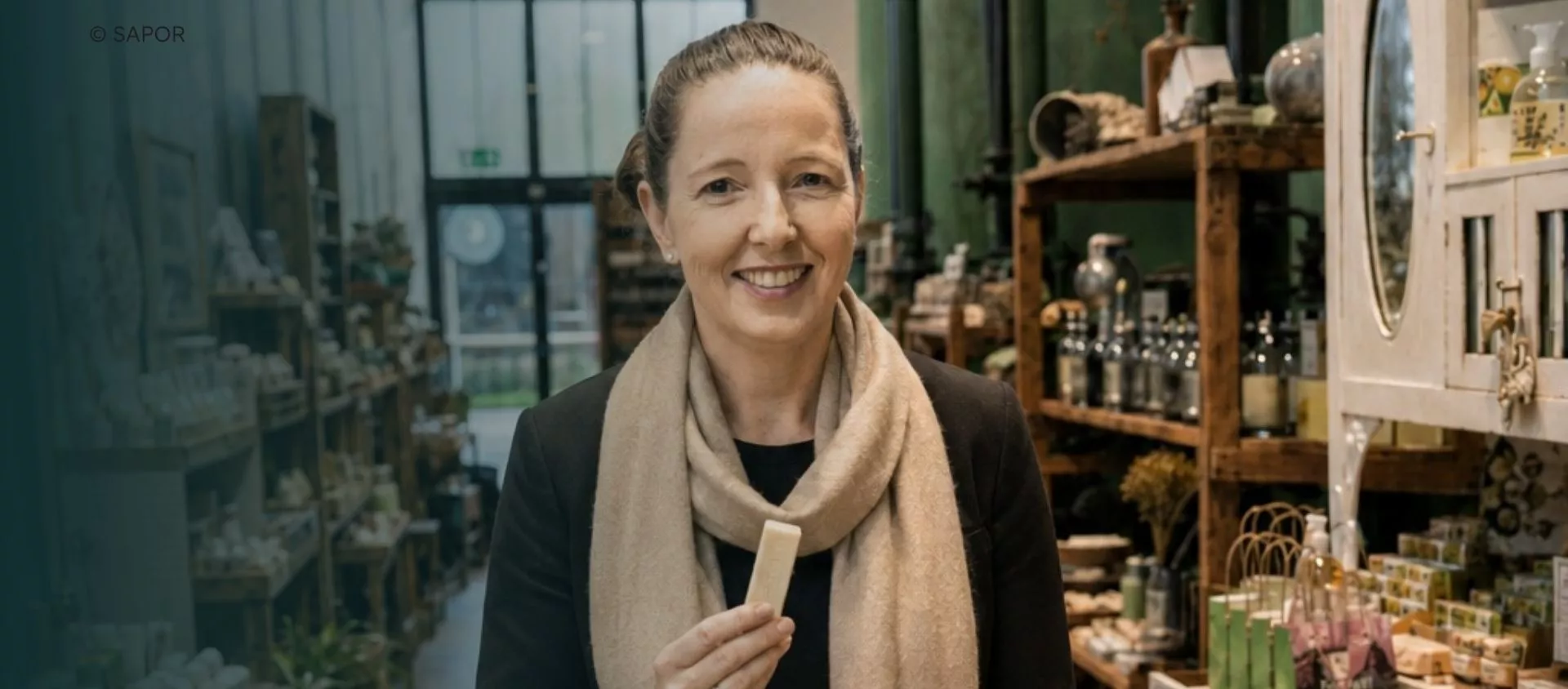
Solid soap reimagined: SAPOR at GutesKlima.NRW
What seems routine when washing your hands has consequences for packaging volumes, transport and resource use. This is precisely where SAPOR comes in. GutesKlima.NRW, an initiative of the Ministry of Economic Affairs of North Rhine-Westphalia, visited us at Zollverein and shows in its current profile how solid soap, long-lasting dispensers and the circular economy can work together.
The article “A round thing” takes a look behind the scenes at SAPOR. It shows why a product is not sustainable simply because it is made from a particular material. What matters is the entire system: How efficient is the soap? How long does the dispenser remain in use? Can it be repaired? And what happens to material and soap remnants when they can no longer be used?
A small decision with a noticeable impact
Liquid soap consists largely of water. That water is filled, stored and transported. In addition, there are bottles, cartridges or refill pouches that have to be replaced and disposed of regularly. With SAPOR, the soap comes as a solid bar for the dry soap dispenser. A short turn releases fine soap flakes. The required amount can be lathered directly with water.
The principle is simple, but effective in everyday life. A 40-gram SAPOR soap bar is equivalent to around one litre of liquid soap and provides up to 400 hand washes. This means less volume in storage and transport, longer refill intervals and significantly less packaging material. At the same time, the bar is used completely. There are no liquid residues left in a cartridge.
For private households, this is an uncomplicated way to reduce packaging waste in the bathroom or kitchen. In offices, schools, workshops, hospitality and public facilities, there is another advantage: anyone who has to refill less often also reduces procurement, storage and maintenance effort.
The dispenser is part of the solution
The circular economy does not begin with recycling, but with service life. A product that has to be replaced after a short time continually consumes new raw materials. SAPOR dry soap dispensers are therefore mechanically designed, robust and repairable. When a component wears out, the entire dispenser does not automatically need to be replaced. Spare parts and refurbishment extend its service life and preserve the value of the product.
Material selection is also being developed further. The GutesKlima.NRW profile presents a housing material that combines recycled plastic with a high proportion of grass fibres. This approach shows what SAPOR is all about: using available raw materials intelligently, considering material cycles and at the same time building a product that performs in daily use.
The same principle applies to the soap. Production remnants are returned to manufacturing instead of being disposed of unused. The vegetable-oil-based soaps are biodegradable, and shipping takes place without plastic packaging. This does not create a single “green” measure, but a series of concrete decisions along the entire product lifecycle.
The circular economy, clearly explained
The two GutesKlima.NRW reels get to the heart of the topic. The first reel at Zollverein explains how the circular economy works in practice with a SAPOR dry soap dispenser. The second reel shows why solid soap is a particularly simple way to avoid plastic waste in the bathroom.
The central idea is not about doing without. A good product must prove itself in everyday life, feel good to use and work reliably. Only then can a more resource-efficient solution become the better long-term habit. This is exactly why SAPOR combines solid soap with a dispenser that portions cleanly and can be used for many years.
Less consumable material, less effort
When buying a soap system, it is not only the initial price that matters. Regular refills, packaging, storage space and defective dispensers create additional costs over the years. An efficient soap bar and a repairable dispenser address several of these points at once. That makes the SAPOR system interesting not only for people who want to avoid plastic, but also for facilities and businesses seeking to run their washrooms more economically.
Our article on cost-efficient hygiene in schools also shows how large the difference can be with intensive use. It focuses on availability, maintenance effort and operating costs. In the private bathroom, the scale is smaller, but the principle remains the same: the longer the dispenser is used and the less packaging is needed for new soap, the more convincing the system becomes.
Which SAPOR solution suits you?
To get started, you need a dry soap dispenser and the matching solid SAPOR soap. Afterwards, only the soap bar is replaced. The dispenser remains. Different models, colours and soaps are available depending on where it will be used. This makes the system suitable for your own bathroom, kitchen sink, guest toilet or commercially used washrooms.
The combination of dispenser and soap also makes a good gift. It is high-quality, practical and communicates its idea not through grand promises but through every use. Anyone who already owns a SAPOR dispenser can choose a suitable dry soap directly and continue using their existing system.
Rediscover solid soap
The GutesKlima.NRW article makes visible what SAPOR has pursued for many years: good design, a long service life and careful use of materials belong together. The simplest way to get started is at the sink.
Discover SAPOR dry soap dispensers and solid soaps in the shop now.
GutesKlima.NRW on SAPOR
Read the article “A round thing”
Watch the first reel: the circular economy at SAPOR
Watch the second reel: avoiding plastic waste with solid soap